
Cryptominium essays · No. 1 · 13 October 2026
A price is not a sale
Every crypto app shows a price. Multiply it by what you hold and you get a number that looks like money.
It isn't money yet. It becomes money when someone buys it from you, and what they pay is often a different number.
The price on the screen is the last trade, usually a small one. It tells you what someone paid a moment ago. It says nothing about whether the market can take what you hold.
A price tells you what the last trade was. A sale tells you what you get.
What we measured
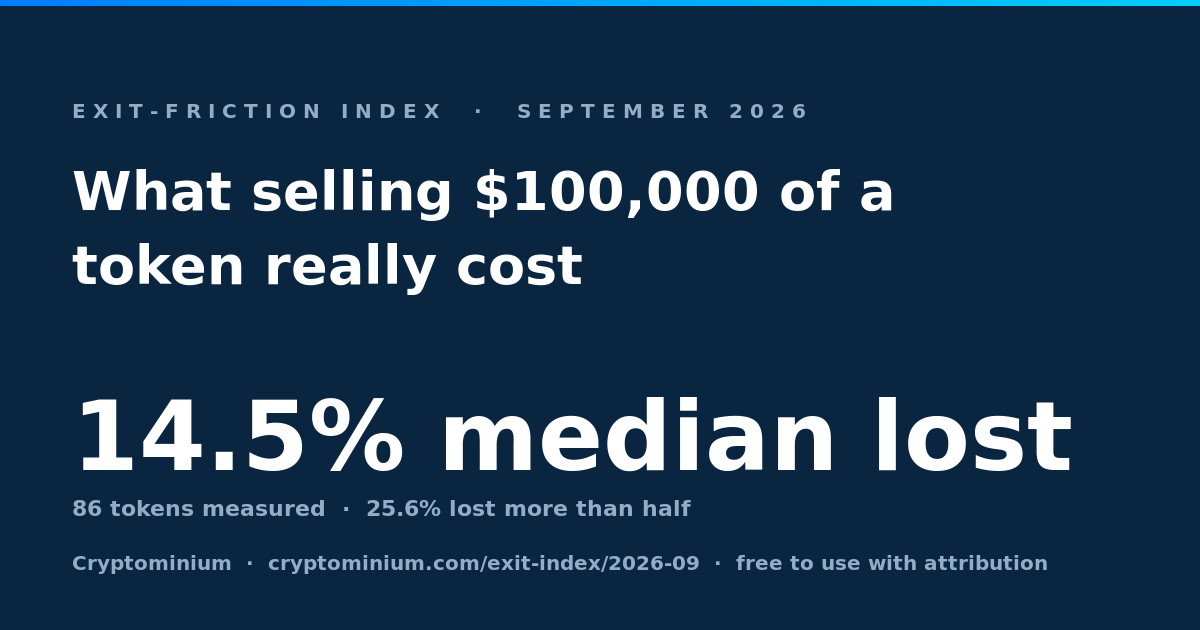
Every day, Cryptominium asks the live on-chain markets on Base and Ethereum one question: if someone sold $100,000 of this token right now, how many dollars would come back? We don't sell anything. We ask for a quote and record the answer.
In September 2026 we measured 86 tokens.
- The typical token lost 14.5% on the way out: $100,000 on the screen, about $85,500 in hand.
- One in four lost more than half.
- At the top, nine tokens cost less than 1%. AERO on Base returned the full $100,000. DAI on Ethereum cost about a tenth of a percent.
- At the bottom, four tokens lost more than 99%. A $100,000 position on the screen came back as less than $1,000.
Every one of those tokens had a price.
Same coin, same price, different sale
A token has one price wherever you look it up, but it doesn't have one sale. The sale depends on where you stand.
| Token | Sold on | Lost | $100,000 came back as |
|---|---|---|---|
| 1INCH | Ethereum | 1.6% | $98,400 |
| 1INCH | Base | 98.5% | $1,500 |
| DEGEN | Base | 7.2% | $92,800 |
| DEGEN | Ethereum | 91.8% | $8,200 |
| VIRTUAL | Base | 0.2% | $99,800 |
| VIRTUAL | Ethereum | 13.0% | $87,000 |
Median over the days measured in September 2026.
Same token, same price, a different sale. Someone holding 1INCH on Base and someone holding it on Ethereum see the same number on their screens. Only one of them could sell close to it.
Some tokens trade mostly on exchanges such as Kraken or Coinbase, and there the sale can be close to the price. It needs an account there, a country the exchange serves, checks passed, and the tokens already deposited. That is a real market, but not everyone is standing in it.
Why this matters for the industry
Market value is price times supply. It takes the price-is-a-sale mistake and multiplies it by every coin in existence.
Critics say crypto values are made up. Promoters quote market caps. Both are arguing about the price.
The honest answer is in between, and it can be measured. Many tokens sell close to their price. That is a real market, and it is evidence. Many don't, and saying so is what makes the first claim believable.
An industry that wants to be trusted by banks, courts, regulators and families should quote what can be sold, not what is printed.
What this is not
- Not advice. It says what a sale would have returned, not whether anyone should make one.
- Not permanent. Markets deepen and dry up. These are September's figures. Every day's are on each token's page.
- One size. $100,000 is a fixed size so that tokens can be compared fairly. A smaller sale loses less, and a larger one loses more.
Sources
All Cryptominium, September 2026, final: the Exit Index for September 2026, the token pages linked in the table, AERO on Base and DAI on Ethereum. Every token, every month: the dataset, free under CC BY 4.0. The chart: Exit Index, September 2026 (PNG).
Borrow this
Free to quote, copy and reuse, with credit, under CC BY 4.0.
Quote“A price tells you what the last trade was. A sale tells you what you get.” (Cryptominium)
CiteCryptominium, "Exit-friction index, 2026-09", measured 2026-10-01. https://cryptominium.com/exit-index/2026-09
Linkhttps://cryptominium.com/essays/a-price-is-not-a-sale
Measurements, not advice. Cryptominium does not recommend buying, selling or holding anything.